

3 Reasons Your Team Keeps Missing the Mark (None of Them Is Talent)
Why your team can't execute against standards that live only in your head

TL;DR You keep concluding your team can’t execute. But they’re aiming at standards that are invisible, arbitrary, and ever-shifting — the three properties your preferences pick up when they live only in your head. That’s the real diagnosis behind “I’m the bottleneck.”

Dana runs a compliance consultancy. Nine people, about $3M. Last quarter the work kept coming back wrong, the senior hire she’d been so sure about was underperforming, and projects would live in green status — right up until the last minute, when they’d “suddenly” slip into significant delays.
She ran the math and landed on the obvious answer: the team can’t execute.
And it’s a fair conclusion. The inputs were all real, the redone work, the slipped deadlines, the senior hire treading water.
But the math had a flaw. Her team was being asked to hit standards that weren’t written down, couldn’t be explained, and wouldn’t sit still. That’s not a performance problem. That’s a clairvoyance problem. And it wasn’t in the job posting.
You’ve probably run Dana’s math about your own team, more than once. But, before you land on your own the answer, look at the inputs:
Your business runs on your preferences. So does every founder-led business, and it’s a big part of why yours works. The trouble starts with where your preferences live: unspoken, unwritten, inside your head.
From in there, they pick up three properties nobody can build against
.
Invisible
Your standards exist, but they’re only in your head, which is closed for visits.
You know exactly what done well looks like. You’ve never said it out loud, and you’ve certainly never written it down. So your team can’t perform against them. They have one workflow available: guess, check with you, wait.
Result: The only reliable way to hit your standards is to route the work through you.
Arbitrary
It’s right because it’s yours.
When you make a call, you don’t explain it and you don’t defend it. It’s right because you made it. Which means the next call could go the other way for the same reason, because that one’s yours too.
Your team watches the decisions get made, but the reasoning never comes with them, so there’s nothing to learn and nothing to reuse.
Result: Every decision is a one-off. The team can quote your last call, but they can’t predict your next one.
Ever-Shifting
This month’s priority, last seen alive on Friday.
You’re an idea volcano. You change your mind in small ways and big ways, all the time, and the thing that displaced this month’s priority was something you read over the weekend. So your team is still executing last month’s plan — at full effort, in a direction you quietly abandoned.
Result: Priorities don’t hold still long enough to build against.
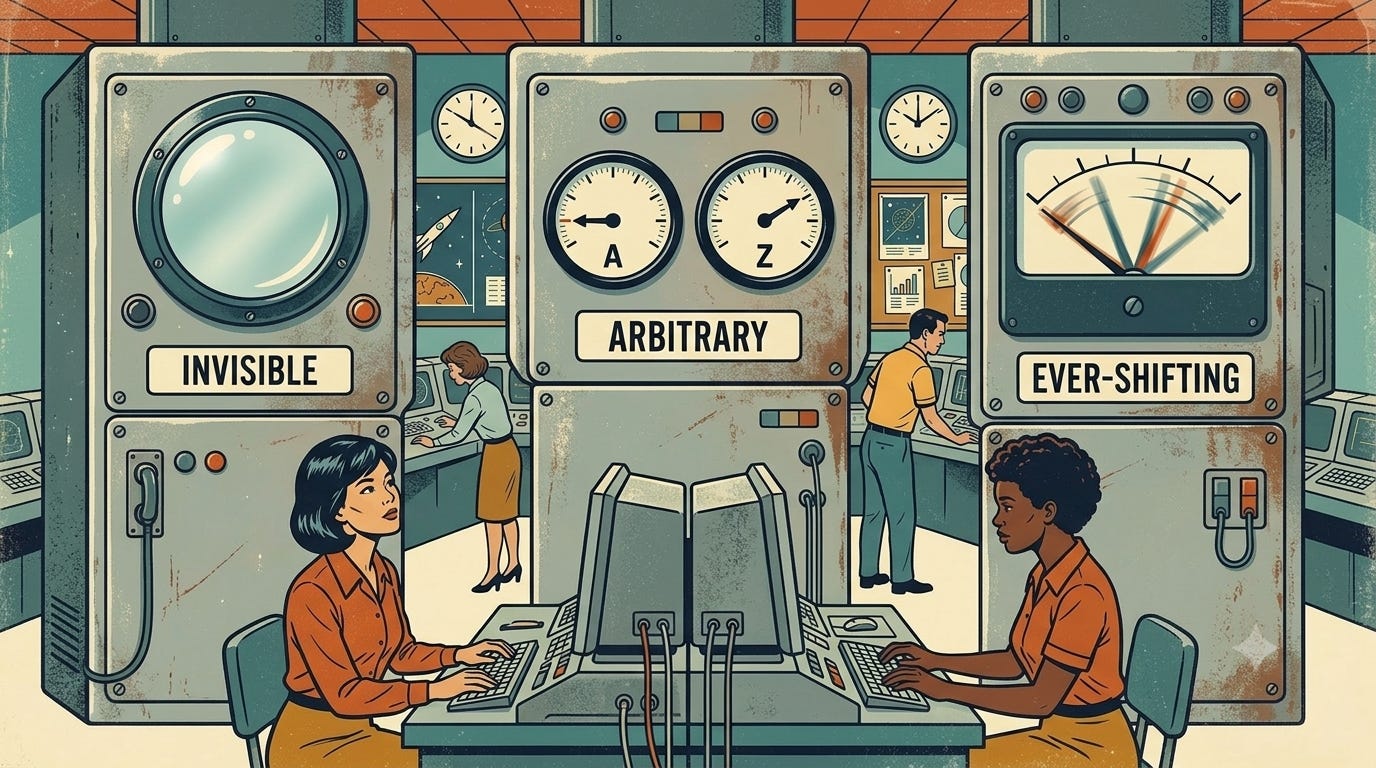
None of this is a team failure, and none of it is a flaw in you. Preferences-in-your-head is exactly how you moved fast when the business was smaller. You met the demand of the moment, you moved on, and it worked. The habits that built the business are the same habits now bottlenecking it.
The habits that built the business are the same habits now bottlenecking it.
Notice who succeeds inside this setup: the people with constant access to you. The ones who can ping you all day and catch your changes in real time.
Which is the very thing you’re complaining about.
That’s the system working the only way it can. Standards that are invisible, arbitrary, and ever-shifting produce a business where everything routes through you, every decision waits on you, and every plan needs your sign-off. (AI can’t build against those three properties either, in case you were counting on the robots.)
I wrote more on this subject here: