

Why Reading About Bottlenecks Won't Remove Yours
Knowing your bottleneck and removing it are two different jobs

TL;DR: You’ve read the books, you can explain the pattern, and the decisions still land on your desk. Knowing your bottleneck and removing it are two different jobs, and this is the story of the second one.

When Sri first called me, he was running a 31-person corporate services firm in Singapore that helped international companies expand into APAC, and nothing inside the business was moving. Initiatives stalled half-finished. Decisions he’d handed off looped back to him anyway, and his weeks went to spinning plates instead of moving the key work forward.
Before he called anyone, Sri did what smart founders do. He read.
In his words: “My business and I were both in stagnation. We were just spinning our wheels. I was voraciously reading anything I could find on bottlenecks, including a number of books that did help but were not enough to get over the mark.”
I want to sit on that sentence, because it is the most honest description I’ve heard of a ceiling most founders hit without ever naming it.
The books did help. And they were not enough to get over the mark. Both of those were true at the same time, and if you own a shelf of operations books and a business that still routes through you, both of those are probably true for you too.
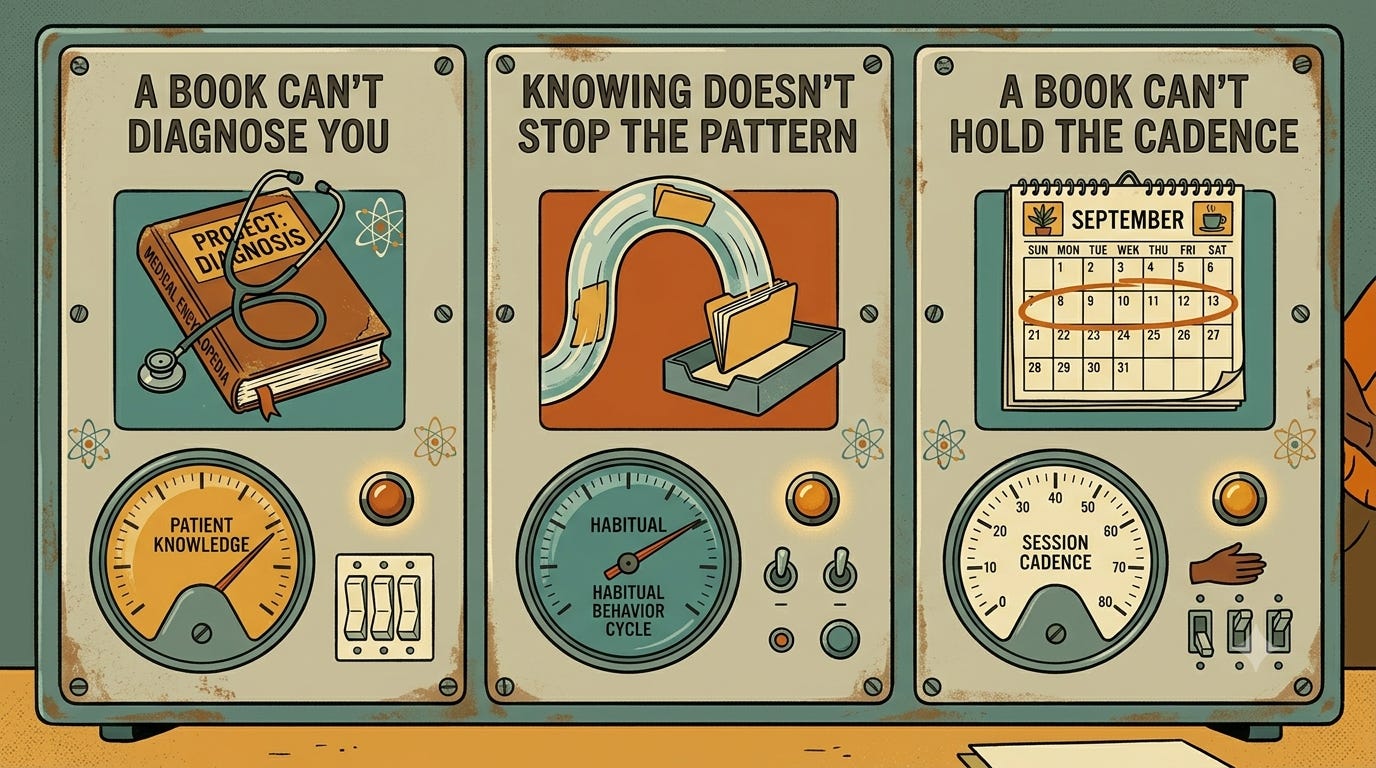
That isn’t a failure of the books, and it isn’t a failure of the reader. A book’s helpfulness runs out at three specific points, and Sri hit all three.
A book can’t diagnose you.
It describes the disease at the population level, and you have to find your version from inside your own company, which is the single worst vantage point for the job (because the whole system is built around you and has been for years).
Sri could talk bottleneck theory with anyone by then. The first thing we built was a diagnostic, to surface the real pattern behind his stalled execution, and that is a step no book can run on your business.
Knowing the pattern doesn’t stop the pattern.
After all that reading, the decisions kept looping back to Sri because the loop was structural. Ownership at his leadership layer was fuzzy, and every unowned decision has a default owner, and the default owner is always the founder.
So we named what each leader owned, put decision rights on paper, and redesigned the delegation paths so work stopped snapping back to his desk out of habit.
A book can’t hold the cadence.
Five-weeks-in is where most interventions quietly die. Pressure hits, a client escalates, and everyone reaches for the old way because the old way feels faster in a pinch.
Sri’s engagement with me ran on a weekly cadence that kept priorities stable under pressure and dug for the root cause of each week’s friction. Clarity turned out to be something we forced repeatedly, not something he achieved once and was done.
The results began to accumulate: Fewer tasks and decisions defaulted to Sri. His leadership team started carrying the operational load, and projects moved forward instead of stalling at the halfway mark.
His own summary: “I’ve gotten my only scarce asset, my time, back to use towards more useful things. I’ve also increasingly removed myself as a bottleneck in my business. Finally, we’re starting to be able to focus on the things that matter again, and I have a much better understanding of how to prevent new bottlenecks from appearing.”
The reading was never wasted. It carried Sri to recognition that he needed outside expert support. The distance between naming your bottleneck and removing it is structural work, done inside your specific business, on a cadence, with someone who can see the system from outside it.
And yes, you’re reading this, so this essay has the same ceiling as the books on Sri’s shelf. It can show you the mark. It can’t get you over it.
If you’ve done the reading and the decisions still route through you, this is the problem I solve and my services page shows what that looks like in practice.
This article is interestingly adjacent to Rosa Horowitch's recent piece in The Atlantic, "The End of Reading Is Here." Horowitch is worried about the end of books. You're saying, "Well, you can get to the end of books and still need something else." Or so I read your good piece.