

What Your Clients Will Expect From You in 2026
(And the 7 Shifts Small Service Teams Must Make to Keep Up)

TL;DR: 2026 is the year small service teams either make delivery measurably faster and more consistent - or quietly lose ground. These 7 trends break down what clients will expect in 2026 and the operational, team and leadership shifts required to deliver.
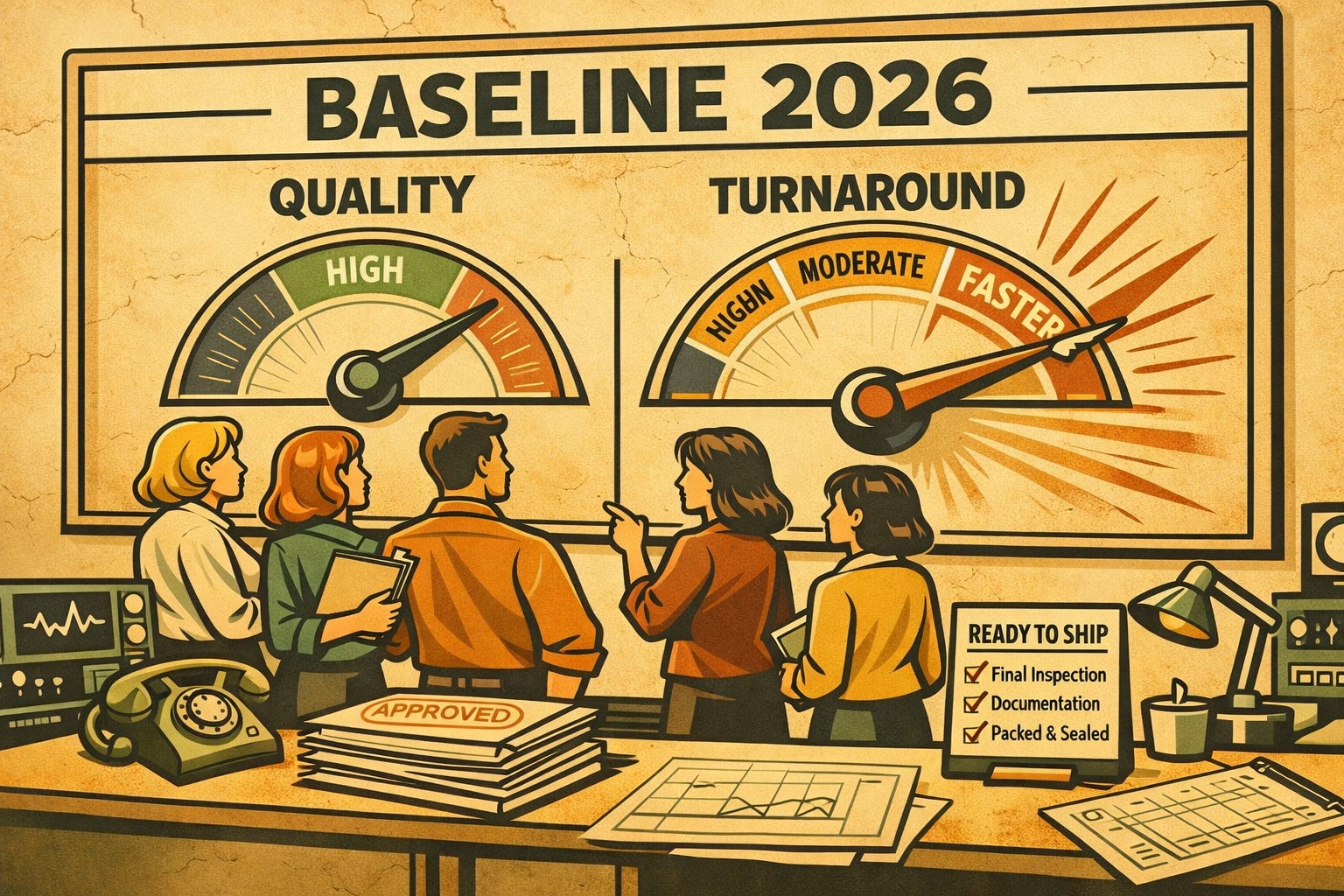
2025 was AI’s “Hot Girl Summer.”1 Excitement, hype and plenty of conspicuous “Look, we’re doing AI” energy dominated the conversation. Everyone wanted to play with prompts, show they were “in the game,” or loudly insist they weren’t.
But as the year closes, the mood has shifted. The novelty has worn off. AI (hype-) fatigue is real. The narrative about LLMs sprinting us toward AGI has cooled for a lot of serious observers.2
And for the teams actually investing in adoption, AI wins have not been easy or automatic. An October survey by Deloitte found that only 15% are seeing significant, measurable ROI from AI so far, while 38% expect to reach it within a year.3 That mirrors what I see with my clients: most of the AI adoption work is ahead of us — and it’s time to get moving.
Translation: if you haven’t fully adopted AI into your workflows, you’re not uniquely behind, but your “dabbling” era is over.
For small, owner-led B2B service teams, the AI upside is still real: a tiny team can dramatically increase throughput and quality without hiring. But many teams are also finding they can’t layer AI on top of “business as usual”. Every brittle system- and owner-bottleneck becomes more visible the moment you try to speed anything up. Dabbling was a reasonable posture in 2025. In 2026, it’s table stakes to get disciplined.
What follows is a clear, grounded look at the external market shifts that will impact small teams in 2026 — and the internal operational, team, and leadership shifts required to compete.
WHAT CLIENTS WILL EXPECT FROM YOU IN 2026
The outside pressures that set the pace for everything else.
1. Clients Already Expect Quality — Now They Will Expect Quality + Quick Turnaround
In 2026, clients will still expect the same high quality, but they will be far less patient with slow cycles and inconsistent pacing. Expect turnaround norms to change substantially: what used to be acceptable in weeks will increasingly be expected in days, with fewer stalls between decisions and deliverables.
Teams will need to find ways to augment human bandwidth with AI and tighter workflows. Turnaround and responsiveness are becoming part of the product. If your cycle time still runs on human bandwidth alone, you’ll feel it first in stalled deals and squeezed margin.
2. It’s Not Just About Speed — It’s Also About New Service Innovations
If you only use AI to speed up drafts and admin tasks, your services will look increasingly generic. In 2026, the differentiator won’t just be how quickly you do the old thing — it will also be how creatively you reshape your services around what AI makes possible. The advantage will go to teams who use AI to deliver deeper insight, not just faster output.
AI stops being a behind-the-scenes shortcut and becomes part of the service model. This rarely requires inventing a brand-new business. For most small teams, “innovation” looks like deeper versions of what you already sell: more insight and analysis, better scenario modeling, faster iteration cycles, and more defensible recommendations.
The most powerful teams in 2026 will use AI as a strategic thought partner — improving planning, prioritization, and insight generation.
HOW YOUR TEAM’S AI HABITS MUST EVOLVE IN RESPONSE
Once client expectations shift, your experimentation habits must shift too.
3. You Must Quickly Move From AI-Dabbling to Noticeably Better Delivery
In 2025, most small teams treated AI as a curiosity, something a person tried when they had time. In 2026, that posture becomes a liability inside the business. The shift isn’t “use AI more,” it’s moving from isolated prompting to consistent workflows that reliably turn inputs into client-ready work.
Teams that operationalize even a few AI-supported workflows compound speed and quality because standards are clearer, handoffs are smoother and fewer decisions snap back to the owner. Dabblers, by contrast, keep paying the inconsistency tax: uneven output, extra review and preventable rework.
This is the prerequisite. The next shift is getting selective about where you apply it.
4. You Must Stop Trying “Everything” and Focus on the Things That Matter
In 2025, teams treated AI like a buffet: try a little of everything, collect a long list of “interesting” use cases, and hope something sticks. In 2026, that approach starts to work against you.
When everything is just an experiment, nothing compounds. Scattershot adoption creates operational noise and uneven quality — which clients experience as slow cycles and uneven quality. You don’t need more AI activity. You need targeted performance gains in the places that actually determine delivery.
This trend is closely tied to Trend 3, but the forcing functions are different. Trend 3 is market-driven: external pressure means dabbling is no longer safe. Trend 4 is behavior-driven: even after accepting that reality, many teams keep flailing — chasing “sexy” use cases and generating motion without forward progress. The shift here is not “use AI more.” It’s stop shopping - start applying.
N/B: How To Determine “The Things that Matter”:
Practically, “the things that matter” means choosing 1-2 workflows where faster cycles or higher-quality judgment will be client-visible and provable.
For most small service teams, that tends to be places like proposals and scoping, client onboarding, recurring reporting or analysis, review-and-revision loops, or the small decisions that keep delivery from stalling.
Then define what a measurable lift looks like before you touch tools: reduced turnaround time, fewer owner approvals, fewer revision cycles, more consistent output quality, or increased delivery capacity without adding headcount.
That’s the point of the shift from scattershot to surgical: fewer experiments, chosen on purpose, tied to metrics you can actually feel in delivery.
WHAT THIS WILL DEMAND OF YOUR TEAM
Internal friction becomes impossible to ignore once the market speeds up.
5. You Must Solve Owner-Bottlenecks Once and For All
As client expectations speed up, owner bottlenecks stop being a manageable annoyance and start becoming a competitive constraint.
In 2025, a lot of small teams could still “make it work” through owner intuition, proximity and last-minute heroics.
In 2026, that approach gets punished, because the pace of delivery and the volume of decisions required to keep work moving will outstrip what one person can hold in their head. The result is predictable: projects stall waiting for your input, the team hesitates without you, and the business can’t expand capacity even when demand is there.
AI doesn’t remove this constraint; it just exposes it.
Here’s the hard line: you can’t expect a meaningful upside to AI adoption while these bottlenecks remain. The bottlenecks are the ceiling. Automating other parts of the workflow doesn’t raise that ceiling; it just produces more volume that still needs the same missing context and the same owner decisions.
The teams that compete well won’t be the ones with the most tools. They’ll be the ones whose systems can stand on their own: clear expectations, repeatable inputs, defined ownership, and a shared definition of “good.”
This isn’t about removing the owner from the business. It’s about removing the need for constant owner intervention so the team can maintain quality and momentum without waiting on you.
6. You Must Move From Unwritten Rules to Codified, Transparent Systems
When you’re “moving too fast to document”, the work moves fastest for whoever can read the owner’s mind, has the most context, or has been around the longest.
That’s tolerable when pace is slower and the team is stable. It collapses when clients expect faster cycles, when contractors rotate in and out, and when you’re trying to use AI to accelerate anything.
In 2026, teams that compete will shift from implicit norms to shared clarity: a visible playbook that captures standards, decision criteria, and the context that makes work “good.”
Codification doesn’t have to mean heavy documentation. It means making the critical rules legible: what matters, what “done” looks like, who decides, what gets escalated, and what examples define quality.
That’s what turns AI from random drafts into consistent, usable output. It’s also what makes delivery more reliable for clients, because quality stops depending on luck, clairvoyance, or who happened to be in the room.
QUICK SELF CHECK: Are These Patterns Showing Up in Your Delivery?
If you recognize these patterns, speed and clarity are already competitive requirements in your market.
Clients are asking for faster turnaround or more responsiveness.
Your proposals and delivery timelines haven’t shrunk in the past year.
You have more AI tools than functioning AI workflows. Adoption is inconsistent across the team.
AI outputs still require heavy owner cleanup or rework because context or judgment criteria aren’t explicit or documented.
You can’t clearly name the 1–2 processes where AI should create measurable lift this quarter.
WHAT THIS WILL DEMAND OF YOU
How your leadership habits must change to accommodate.
7. You Need to Shed Your Indispensable Owner-Doer Role
What this means for your business: You can’t build a durable AI upside on top of an operating model that depends on you constantly playing Helicopter-in-Chief.
In 2026, your leverage has to move earlier in the process: setting standards, shaping decisions, and installing clarity so the team can execute without waiting on your live intervention.
The real shift is learning to lead without hovering, and to stay accountable for outcomes without being the mechanism for every decision.
What this looks like in practice:
You define decision rights and quality standards so fewer questions route back to you.
You create repeatable context (briefs, examples, templates, escalation rules) so the team can execute without mind-reading.
You define explicit “ready-to-ship” success criteria (with examples) so anyone on the team can review work against the same standard and know when it’s client-ready — without waiting for you to be the quality oracle.
When this is working, you’ll feel the emotional terrain shift too: less low-grade anxiety about being constantly needed, fewer moments of frustration when the team doesn’t “just get it.”
You stop proving your value by touching everything and start creating value by creating context, criteria and examples so others can ship work you’re proud of.
That transition can be hard — it can feel like letting go of relevance — but it’s also the most worth-it shift in the whole stack: you move into higher-leverage judgment and direction, and the business stops running on your nervous system.
🚫THE 3–6 MONTH FAILURE TRAJECTORY (WHAT IT LOOKS LIKE IN REAL LIFE)
If a small service team doesn’t respond to the 2026 shifts, the decline usually isn’t dramatic. It’s quiet, cumulative, and easy to rationalize — until it’s expensive.
Cycle time creeps up. Proposals, revisions, and “small decisions” take longer than they really need to.
Approvals pile up. AI increases drafts, but also increases owner review. Your calendar becomes the bottleneck.
Delivery feels inconsistent. Quality is still high, but the client experience becomes uneven: slow weeks, rushed weeks, preventable rework.
Clients stop expanding. They don’t complain. They just reduce scope, delay renewals, or shop around for a faster partner.
Your team compensates. Contractors work around missing context, over-communicate, or wait for direction — and morale quietly dips.
You get busier, not bigger. Revenue might hold, but margin and energy degrade. The business feels heavier.
🚀THE 60–90 DAY WIN TRAJECTORY (WHAT GOOD LOOKS LIKE)
When a small team responds well, the early wins aren’t “we bought the right tool.” They’re operational signals that the business is getting lighter, faster, and more reliable.
One workflow gets rebuilt. You pick a single bottlenecked loop (proposals, onboarding, reporting, revisions) and redesign it end-to-end.
Cycle time drops measurably. Turnaround shortens — and the team sees the proof.
Owner review decreases. AI supports the team’s first draft work and the standards are clear enough that you aren’t rewriting everything.
Quality becomes more consistent. Output varies less by person or week because judgment and context are captured.
Clients feel the difference. Delivery becomes smoother: faster responses, fewer surprises, better clarity. Expansion conversations get easier.
The system compounds. With one win installed, the team repeats the approach on the next bottleneck, and the next — and you start to feel capacity open up.
Where to Start This Quarter
You don’t need to become an AI-first company in 2026. You need to become a company whose delivery can keep up with what clients are about to expect: faster cycles, clearer work, fewer stalls, more consistent quality.
The teams that win won’t be the ones with the most tools. They’ll be the ones who make a handful of operational shifts that compound: pick one bottleneck, rebuild the workflow, make success criteria explicit, reduce owner review, then repeat.
If you’re reading this and thinking, “We’re already feeling the pressure,” that’s actually good news. It means you’re paying attention early enough to respond on purpose. Choose the first workflow you want to make measurably better this quarter. Install the win. Let it compound.
And if you want a partner to help you identify the highest-leverage bottleneck, design the standards and decision system around it, and turn AI experimentation into reliable delivery improvements, reach out.
Hat tip to several folks using this phrase, which I first saw here on Substack.
Gary Marcus speaks eloquently about this in his Substack, especially here.